Scott County Dog Registration Information
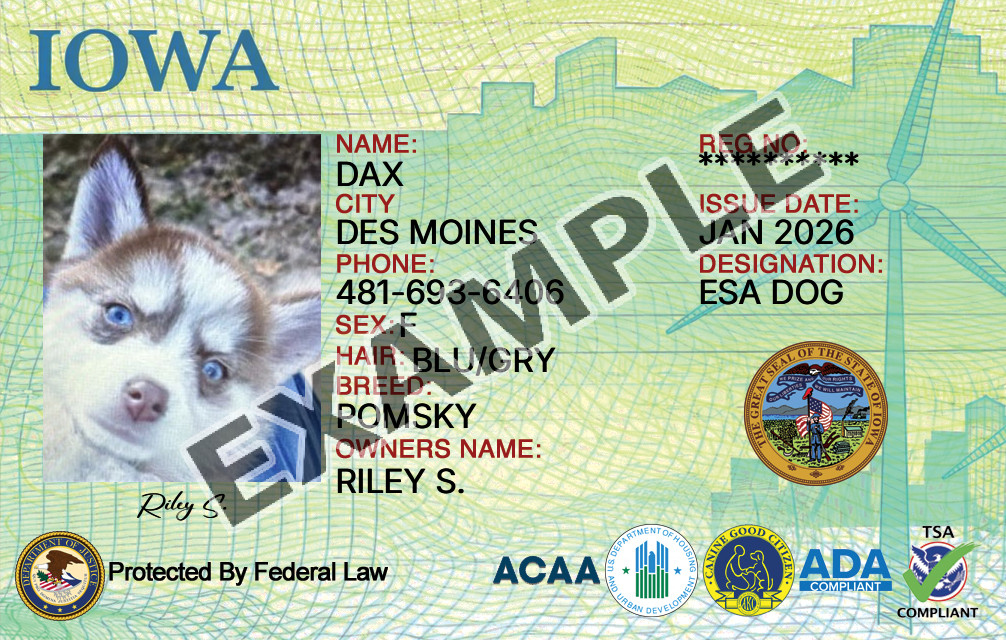
Service Dogs and Emotional Support Animals in Scott, Iowa
If you’re searching where do I register my dog in Scott County, Iowa for my service dog or emotional support dog, it helps to separate two different things: (1) a local dog license in Scott County, Iowa (usually handled by your city or a contracted animal services office), and (2) your dog’s service dog or emotional support animal (ESA) status (which is not created by a universal federal “registration” database). This page explains where to register a dog in Scott County, Iowa, what documents you typically need, and how the rules differ for a pet license vs. a service dog vs. an ESA.
Where to Register or License Your Dog in Scott County, Iowa
The offices below are the most relevant official local contacts for animal control dog license Scott County, Iowa questions and for purchasing city pet licenses (where applicable). Use the office that matches your city of residence or the service area described.
Humane Society of Scott County (HSSC)
- Phone: 563-388-6655
- Email: adoptions@hssc.us
-
Hours (as posted):
12:00 pm – 05:30 pm
Bettendorf City Hall (Bettendorf City Offices)
- Phone: 563-344-4000
- Email: info@bettendorf.org
-
Office Hours (as posted):
Mon–Fri: 8:00 am – 5:00 pm
Overview of Dog Licensing in Scott County, Iowa
Dog licensing is usually a city requirement
In many Iowa counties, dog licensing requirements are set by local ordinances (city or town rules) rather than a single countywide “dog registry.” In Scott County, the correct place to license your dog often depends on whether you live within a city such as Davenport or Bettendorf, or in another Scott County community.
Why licensing matters (even for service dogs and ESAs)
A dog license is generally a local registration record used for identification, rabies compliance tracking, and animal control reunification if a dog is found at large. Even if your dog is a service dog or an emotional support dog, local licensing rules may still apply because licensing is about public health and identification, not disability status.
Rabies vaccination is commonly required
Local ordinances frequently require proof of a current rabies vaccination (signed/issued by a licensed veterinarian) to obtain or renew a license. Many municipalities also set timelines for obtaining the license after vaccination or after moving into the city.
No single “federal service dog registry”
In the U.S., there is not one universal federal government registry that “registers” service dogs or emotional support animals for the public. Service dog status comes from the dog being individually trained to perform tasks for a person with a disability (and the handler meeting legal definitions), while ESA status relates to disability-related need for emotional support and is typically documented by an appropriate healthcare professional for housing-related accommodations.
What You Need Before Registering a Dog
Documents commonly requested for a dog license
While each municipality can set its own process, many residents should be prepared to provide the following when asking where to register a dog in Scott County, Iowa and then completing the license:
- Proof of current rabies vaccination (rabies certificate signed by a licensed veterinarian)
- Your contact information (name, phone, address)
- Dog details (breed/description, age, color, sex)
- Spay/neuter documentation (if your city uses different fees for altered vs. unaltered dogs)
- Payment for the licensing fee (fees vary by city and dog status)
Service dog or ESA documents: what is (and isn’t) needed
For most local licensing offices, the dog license process focuses on rabies and basic identification. Service dog and ESA documentation usually comes into play in specific contexts (for example, access under disability laws, or housing accommodation requests), not for creating a dog license record itself.
- Service dog: No universal registration is required. The key is training to perform tasks for a disability and meeting legal definitions.
- Emotional support animal (ESA): Typically supported by a healthcare provider letter for housing accommodations, not a local “registration” tag.
Steps to Register or License a Dog in Scott County, Iowa
Step 1: Confirm your local jurisdiction (city limits matter)
Start by confirming whether your address is within Davenport, Bettendorf, or another Scott County municipality. Licensing rules can be different from one city to the next, and some communities route licensing through a city office while others may rely on contracted animal services support.
Step 2: Get your rabies vaccination up to date
Many local offices require proof of a current rabies vaccination before issuing a license. If you are newly adopting a dog or your dog is reaching the age when rabies vaccination is required, schedule the vaccination first so you can provide the certificate.
Step 3: Bring your paperwork and request the correct license type
When you contact or visit the office, ask specifically about licensing for your municipality and whether the city uses different fees for:
- Altered (spayed/neutered) vs. unaltered dogs
- Senior/age-based exceptions (if any)
- New resident timelines and renewal cycles
Step 4: Keep the tag and records current
Licensing typically requires periodic renewal. Keep the license tag information and your rabies certificate accessible, especially if you travel, use local dog parks that require proof, or need to show compliance during an animal control contact.
Service Dog Laws in Scott County, Iowa
Service dog vs. dog license: two different concepts
A service dog is generally defined by what the dog does (trained work or tasks for a person with a disability). A dog license is a local identification and vaccination-compliance requirement. Having a trained service dog does not automatically replace local licensing steps if your city requires licensing for all dogs within city limits.
No universal federal “service dog registration” requirement
In practical terms, you do not “register” a service dog through one nationwide federal government registry to make it a service dog. Service dog legitimacy is based on the handler’s disability-related need and the dog’s task training. Some handlers voluntarily carry training records or a note from a professional, but those are not the same as a government-issued registry.
What you can expect locally
If you are contacting animal services for licensing, the office will typically focus on: your address (jurisdiction), rabies vaccination proof, and local licensing categories/fees. If you have questions about how local ordinances treat working dogs or special situations, ask the licensing office to confirm what applies in your municipality.
| Category | What it is | Main purpose | Typical proof/documentation | Where it’s handled in Scott County, IA |
|---|---|---|---|---|
| Dog License | Local registration record for a dog living in a city/municipality | Identification, rabies compliance, reunification, ordinance compliance | Rabies vaccination certificate; owner/address info; possible spay/neuter proof | Usually your city or its designated animal services partner (varies by municipality) |
| Service Dog | A dog trained to do work or perform tasks for a person with a disability | Disability-related assistance and public access rights where applicable | No universal federal registry; legitimacy is based on task training and disability-related need | Status is defined by law, not by local licensing; licensing may still apply as a separate requirement |
| Emotional Support Animal (ESA) | An animal that provides comfort/support related to a disability | Primarily relevant to housing accommodations (not general public access) | Typically a healthcare provider letter for accommodation requests (housing context) | Status is not created by local licensing; your city’s dog license rules may still apply |
Emotional Support Animal Rules in Scott County, Iowa
ESAs are not “registered” with the county for public access
An emotional support dog is not the same as a trained service dog for public access purposes. In many situations, ESA status is used when requesting a reasonable accommodation in housing. An ESA generally does not receive the same public access permissions as a service dog in places where pets are not allowed.
Dog licensing still may be required by your city
If your municipality requires licensing for dogs within city limits, the ESA designation usually does not remove the requirement to maintain a valid local license and rabies vaccination. In other words, when you ask “where do I register my dog in Scott County, Iowa,” the answer is still based on where you live (city limits) and local ordinance requirements.
Best practice: keep two folders of records
- Licensing folder: rabies certificate, spay/neuter proof (if applicable), license/tag details.
- Accommodation folder (if needed): your ESA letter for housing-related requests, kept private and shared only when appropriate.
Frequently Asked Questions
Where do I register my dog in Scott County, Iowa?
For most residents, you register by obtaining the required city pet license through the correct municipal process. If you live in Davenport, city information indicates licensing questions are handled through the Humane Society of Scott County. If you live in Bettendorf, licensing may be purchased through the Humane Society of Scott County or at Bettendorf City Hall. If you live in another Scott County city or in a rural area, the correct office can vary—contact local animal services to confirm the process for your address.
Do service dogs have to be licensed in Scott County, Iowa?
Service dog status and dog licensing are separate. A service dog is defined by disability-related task training, while licensing is a local requirement tied to rabies compliance and identification. If your city requires licensing for dogs within city limits, you should expect to follow the same local licensing rules unless your municipality provides a specific exemption or special procedure.
Do emotional support animals (ESAs) need a city dog license?
In many municipalities, yes—because the city license is not the same as an ESA accommodation. If your city requires a license for dogs, your ESA generally must still be licensed and vaccinated according to local rules.
What proof do I need to get a dog license in Scott County, Iowa?
A common requirement is proof of current rabies vaccination from a licensed veterinarian. Some cities also use different licensing categories or fees based on spay/neuter status. If you are unsure what your city requires, call the office listed in the licensing section above and ask what documents apply to your address.
Is there a single federal registry I must use for my service dog or ESA?
No. There is not one universal federal government registry that you must use to “register” a service dog or an ESA. Local dog licensing is a separate process and is based on your local city/municipal rules and rabies vaccination documentation.
Register A Dog In Other Iowa Counties
Select your county below to get started with your dog’s ID card. Requirements and license designs may vary by county, so choose your location to see the correct options and complete your pup’s registration.
- Adair Dog License Cards
- Adams Dog License Cards
- Allamakee Dog License Cards
- Appanoose Dog License Cards
- Audubon Dog License Cards
- Benton Dog License Cards
- Black Hawk Dog License Cards
- Boone Dog License Cards
- Bremer Dog License Cards
- Buchanan Dog License Cards
- Buena Vista Dog License Cards
- Butler Dog License Cards
- Calhoun Dog License Cards
- Carroll Dog License Cards
- Cass Dog License Cards
- Cedar Dog License Cards
- Cerro Gordo Dog License Cards
- Cherokee Dog License Cards
- Chickasaw Dog License Cards
- Clarke Dog License Cards
- Clay Dog License Cards
- Clayton Dog License Cards
- Clinton Dog License Cards
- Crawford Dog License Cards
- Dallas Dog License Cards
- Davis Dog License Cards
- Decatur Dog License Cards
- Delaware Dog License Cards
- Des Moines Dog License Cards
- Dickinson Dog License Cards
- Dubuque Dog License Cards
- Emmet Dog License Cards
- Fayette Dog License Cards
- Floyd Dog License Cards
- Franklin Dog License Cards
- Fremont Dog License Cards
- Greene Dog License Cards
- Grundy Dog License Cards
- Guthrie Dog License Cards
- Hamilton Dog License Cards
- Hancock Dog License Cards
- Hardin Dog License Cards
- Harrison Dog License Cards
- Henry Dog License Cards
- Howard Dog License Cards
- Humboldt Dog License Cards
- Ida Dog License Cards
- Iowa Dog License Cards
- Jackson Dog License Cards
- Jasper Dog License Cards
- Jefferson Dog License Cards
- Johnson Dog License Cards
- Jones Dog License Cards
- Keokuk Dog License Cards
- Kossuth Dog License Cards
- Lee Dog License Cards
- Linn Dog License Cards
- Louisa Dog License Cards
- Lucas Dog License Cards
- Lyon Dog License Cards
- Madison Dog License Cards
- Mahaska Dog License Cards
- Marion Dog License Cards
- Marshall Dog License Cards
- Mills Dog License Cards
- Mitchell Dog License Cards
- Monona Dog License Cards
- Monroe Dog License Cards
- Montgomery Dog License Cards
- Muscatine Dog License Cards
- O'Brien Dog License Cards
- Osceola Dog License Cards
- Page Dog License Cards
- Palo Alto Dog License Cards
- Plymouth Dog License Cards
- Pocahontas Dog License Cards
- Polk Dog License Cards
- Pottawattamie Dog License Cards
- Poweshiek Dog License Cards
- Ringgold Dog License Cards
- Sac Dog License Cards
- Shelby Dog License Cards
- Sioux Dog License Cards
- Story Dog License Cards
- Tama Dog License Cards
- Taylor Dog License Cards
- Union Dog License Cards
- Van Buren Dog License Cards
- Wapello Dog License Cards
- Warren Dog License Cards
- Washington Dog License Cards
- Wayne Dog License Cards
- Webster Dog License Cards
- Winnebago Dog License Cards
- Winneshiek Dog License Cards
- Woodbury Dog License Cards
- Worth Dog License Cards
- Wright Dog License Cards
